
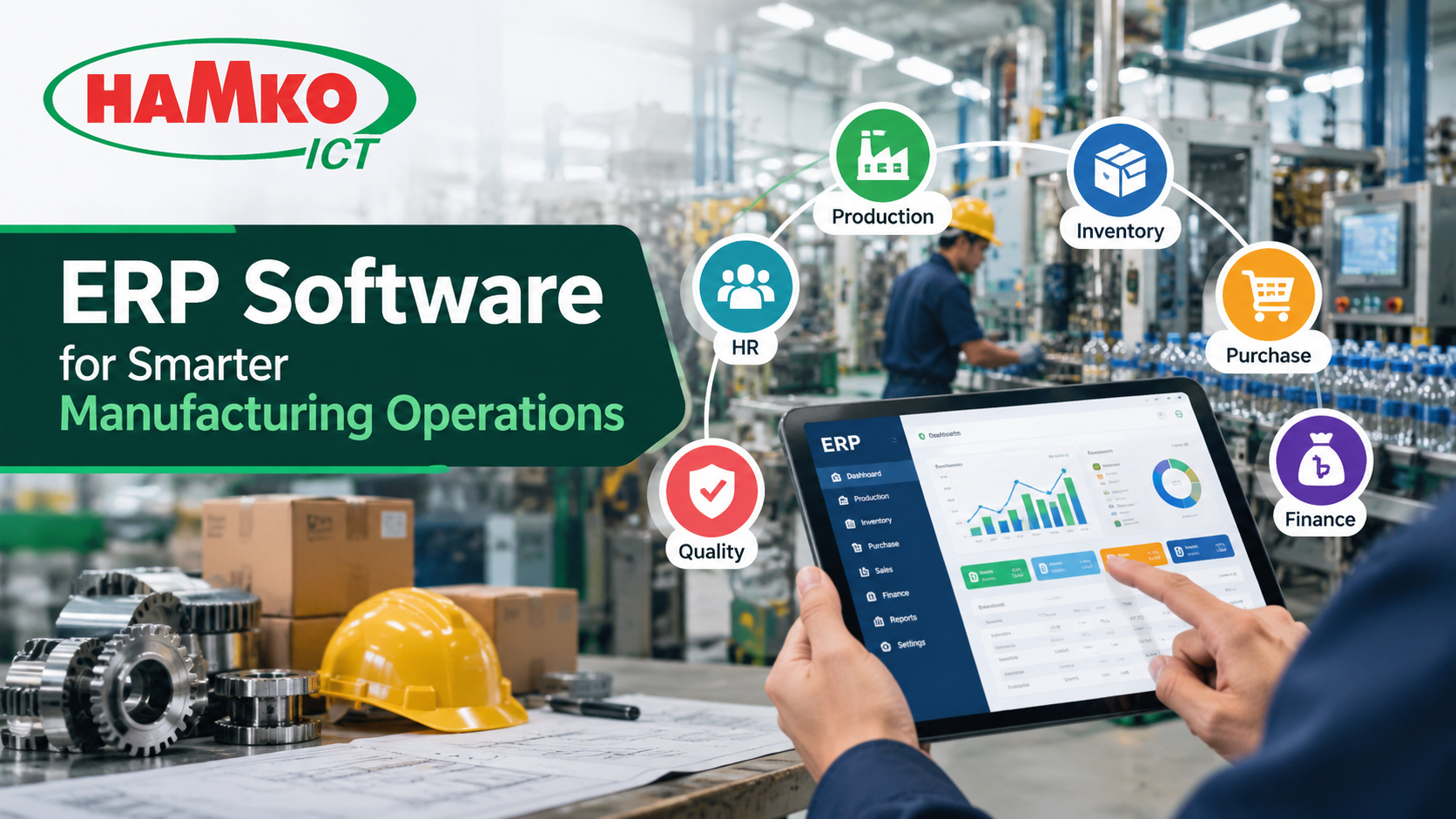
Manufacturing is not simply about producing more products. A factory has to coordinate raw materials, suppliers, machines, workers, production schedules, quality checks, inventory, orders, delivery, and financial information—often at the same time.
When these activities are managed through separate Excel files, manual registers, disconnected software, and phone calls between departments, even a well-run factory can struggle with delays, stock mismatches, production bottlenecks, and inaccurate costing.
This is where ERP software for manufacturing businesses becomes valuable. A manufacturing ERP connects production, inventory, purchasing, sales, finance, and other operational functions through a shared system. Instead of asking different departments for separate updates, management can work from connected operational data.
Modern manufacturing ERP systems typically connect production planning, material requirements planning (MRP), inventory, procurement, quality, finance, and shop-floor activities.
The real value of ERP is not simply storing more information. It is connecting the information so that one operational decision does not create confusion somewhere else.
What Does ERP Do in a Manufacturing Business?
A manufacturing ERP acts as a central operating system for the factory.
For example, imagine a manufacturer receives an order for 5,000 units of a product. That order creates several questions immediately: Do we have enough raw materials? Which materials need to be purchased? How much production capacity is available? Which machines and work centers will be required? When can production start? What will the finished product actually cost? Can the promised delivery date be achieved?
Without an integrated system, these questions may require information from sales, production, warehouse, purchasing, and finance separately.
With ERP, the information can move through a connected workflow. The sales order can influence production planning; production planning can identify material requirements; inventory can show what is already available; procurement can purchase shortages; work orders can guide production; and completed production can update inventory and costing.
That connection is the foundation of manufacturing ERP.
1. ERP Improves Production Planning and Scheduling
Production planning is one of the most important areas where ERP can help a manufacturing company.
A factory needs to decide what to produce, how much to produce, when to produce it, and what resources will be required. These decisions depend on customer demand, available inventory, raw materials, machine capacity, labour, lead times, and existing production orders.
Manufacturing ERP can bring these variables together instead of forcing planners to maintain separate spreadsheets.
Material Requirements Planning, or MRP, is particularly important. It can use information such as bills of materials, current inventory, demand and lead times to help determine which materials are required for upcoming production. ERP Research describes production planning as the process of turning demand into an executable factory schedule while considering material availability, capacity and work orders.
This can help manufacturers move from reactive planning to more structured production management.
For example, if a factory receives a large order but does not have enough raw material, the system can help identify the shortage before production is scheduled instead of discovering the problem after workers are ready to start.
2. ERP Gives Better Control Over Raw Materials and Inventory
Inventory problems can directly affect manufacturing profitability.
Too little raw material can stop production. Too much inventory can tie up working capital and increase storage costs. Manufacturing companies therefore need visibility into raw materials, work-in-progress and finished goods.
An ERP system can maintain inventory information alongside production and purchasing data. When materials are consumed during production, inventory records can be updated. When finished goods are completed, stock can be increased. When purchasing receives new materials, the available inventory can be reflected in the same system.
Modern manufacturing platforms can also support lot and serial-number tracking, which is particularly useful when manufacturers need product traceability. Odoo, for example, documents manufacturing workflows covering inventory integration, lot/serial tracking, quality, production orders and manufacturing cost analysis.
The important point is that inventory should not exist as an isolated warehouse report. It should be connected to what the factory is actually producing and what it expects to produce next.
3. ERP Connects BOM, Production and Product Costing
A Bill of Materials (BOM) defines the materials and components required to manufacture a product.
Suppose a manufacturer produces a finished product using five different components. If the BOM is connected to production and inventory, the ERP system can help determine which materials are required and how those materials relate to the final product.
This also creates an important connection with costing.
Instead of looking only at the purchase price of raw materials, manufacturers can build a more complete picture of production costs by considering materials, labour and operational costs. Manufacturing ERP platforms commonly provide manufacturing-order cost analysis based on components and operations.
This matters because selling price decisions are only as good as the cost information behind them.
If management does not know the approximate cost of producing a unit, it becomes difficult to determine whether a product, customer order or production line is actually profitable.
4. ERP Connects Purchasing With Production Requirements
Purchasing decisions become much more useful when they are connected to actual production requirements.
Consider a factory that is preparing to manufacture 10,000 units. The production plan requires specific quantities of steel, plastic, packaging materials and other components. Some may already be available in the warehouse, while others may need to be purchased.
Instead of purchasing based mainly on manual estimates, an ERP system can connect production requirements with inventory and procurement.
This creates a chain:
Customer Demand → Production Plan → Material Requirement → Inventory Check → Purchase Requirement → Production → Finished Goods
That chain is one of the most important advantages of integrated ERP.
SAP describes manufacturing ERP as a centralized system connecting production, procurement, supply chain and finance, with MRP helping ensure materials are available when production requires them.
5. ERP Improves Shop-Floor Visibility
Management may know how much production was planned without knowing what is actually happening on the factory floor.
A production order may be delayed because a machine is unavailable, a component has not arrived, a quality problem has been detected, or an earlier job has taken longer than expected.
Shop-floor functionality can bring production progress back into the ERP system.
Modern manufacturing systems can support work orders, work centers, production confirmations, quality checks, maintenance requests and operator updates. Odoo, for example, provides work-center controls designed to let workers manage work orders and production activities in real time.
This creates a valuable difference between planned production and actual production.
Managers can then ask better questions: Which production order is delayed? Which work center is creating a bottleneck? How much has already been produced? How much remains? Why did the schedule change?
6. ERP Helps Manage Quality, Waste and Traceability
Manufacturing efficiency is not only about producing more units. The factory also needs to produce the right quality.
Quality problems can occur at different stages: during raw-material receiving, production, assembly, packaging or final inspection.
ERP can connect quality checks with production records and inventory information. If lots or serial numbers are tracked, manufacturers can also improve traceability across the production process.
This becomes especially important when a company needs to investigate defective products, identify affected batches, or understand where a quality problem originated.
Modern manufacturing ERP platforms can include quality alerts, quality checks, scrap tracking and traceability features.
For a growing manufacturer, this turns quality management from a collection of paper records into a more structured operational process.
7. ERP Connects Machine Maintenance With Production
Machines are productive assets, but machine downtime can disrupt an entire production schedule.
Suppose a critical machine unexpectedly stops for several hours. Production may be delayed, workers may become idle, delivery commitments may be affected, and the factory may need to change its schedule.
An integrated ERP environment can connect maintenance information with production planning. Maintenance activities can be planned around equipment availability rather than being treated as a completely separate process.
A real-world example comes from Litoplas, a packaging manufacturer founded in 1967. After extending its Oracle Fusion Cloud environment into manufacturing and supply chain operations, the company reported a 40% increase in production, machine availability improvement of up to 6%, and a 15% reduction in its maintenance budget. These are company-reported results, not a universal expectation for every ERP implementation.
The lesson is important: ERP becomes more powerful when maintenance, inventory, purchasing and production are connected rather than managed independently.
8. ERP Gives Management a Better View of Business Performance
One of the biggest operational problems in manufacturing is not always a lack of data—it is having data in too many places.
Production may have one report. Warehouse may maintain another. Finance may have a different set of numbers. Management then spends time collecting and reconciling information before making a decision.
ERP can create a shared operational data environment.
Management dashboards can help track production output, inventory levels, material consumption, purchasing, order status, production costs and other KPIs.
This means a factory manager does not have to wait until the end of the month to discover that production performance has moved away from plan.
Good ERP reporting does not replace management decisions. It gives managers better information on which to make those decisions.
A Real ERP Lesson From Hershey
ERP can deliver major operational benefits, but implementation itself must be managed carefully.
Hershey Foods experienced major problems during its 1999 ERP rollout. The implementation was delayed, and the company moved several systems into production using a “big bang” approach. Problems with order processing and fulfillment followed, and retailers experienced delivery problems even though products were available in warehouses. Computerworld reported that Hershey's fourth-quarter 1999 sales and profits both declined 11%, with the company attributing the results partly to continuing order-processing problems.
This historical example demonstrates an important point: buying ERP software is not the same as successfully implementing ERP.
Businesses need proper process mapping, data preparation, testing, user training, integration planning and phased implementation where appropriate.
Hershey later upgraded its SAP R/3 environment successfully, completing the upgrade 20% under budget without repeating the order-processing and shipment disruptions of the earlier rollout.
What Should a Manufacturing Business Look for in an ERP?
Before choosing an ERP system, manufacturers should look beyond a long feature list.
The system should fit the company's actual production model and workflows. At minimum, manufacturers should evaluate production planning, BOM management, inventory, procurement, work orders, costing, quality, maintenance, reporting, accounting integration, user permissions, security and scalability.
The system should also be able to integrate with the tools the business already uses.
For a Bangladeshi manufacturing company, additional considerations may include local accounting and tax requirements, multiple warehouses, supplier management, production costing, approval workflows, employee roles and the ability to customize the system around existing factory processes.
The objective should not be to find an ERP with the most features. The objective should be to find an ERP that can accurately represent how the factory actually operates.
Final Thoughts
ERP software can help manufacturing businesses move from disconnected information and manual coordination toward a more connected operating model.
From production planning and raw-material management to procurement, BOM, costing, shop-floor operations, quality, maintenance and financial reporting, ERP brings different parts of the manufacturing cycle into one connected system.
The biggest benefit is therefore not simply automation. It is operational visibility.
When production, inventory, purchasing, finance and management are working from connected information, businesses can identify problems earlier, coordinate departments more effectively and make decisions based on the current state of the operation.
For manufacturers considering digital transformation, the right approach is to first map the production workflow, identify the biggest operational bottlenecks, and then select or develop an ERP system around those requirements.
For businesses in Bangladesh looking for custom ERP software development, the system can be designed around specific manufacturing workflows rather than forcing every department to change its process simply to fit generic software. HAMKO ICT can help businesses evaluate their requirements and develop integrated software solutions around production, inventory, accounting, sales and other business operations.
